
The new SEO acronyms appearing across digital marketing circles — AEO (Answer Engine Optimisation), GEO (Generative Engine Optimisation), AIO (AI Optimisation), and LLMO (Large Language Model Optimisation) — all describe the same basic shift: optimising content so AI systems like ChatGPT, Claude, Gemini and Perplexity cite your business when someone asks a question. The tactics differ in detail, but the goal is identical across all four labels.
As if digital marketing wasn't complicated enough, we now have this fresh batch of acronyms competing for your attention. So much for the KISS principle — "Keep It Simple, Stupid."
The reality? These terms are marketing rebrands of something you're likely already doing if you write useful, specific content that answers real questions. It is also another example of false SEO information dressed up as something new.
What does each acronym claim to mean?
All four terms describe strategies to make your content visible and quotable to large language models (LLMs) and AI-powered search tools.
| Acronym | Full Name | What It Claims To Do |
|---|---|---|
| AEO | Answer Engine Optimisation | Optimise for tools that answer questions directly (ChatGPT, Claude, Perplexity) |
| GEO | Generative Engine Optimisation | Optimise for AI that generates answers by pulling from multiple sources |
| AIO | AI Optimisation | Broad term covering any content strategy aimed at AI visibility |
| LLMO | Large Language Model Optimisation | Optimise specifically for models like GPT-4, Claude 3, or Gemini |
How the four terms overlap
The distinctions are mostly academic. In practice, the tactics overlap almost completely: clear structure, factual specifics, cited sources, quotable sentences, and content that directly answers what people ask.
Why are these terms appearing now?
Where people start their searches
Search behaviour is fragmenting. Google still delivers the most traffic, even with the decline of the click from AI-generated results appearing at the top of the page. But users increasingly start queries in ChatGPT, Claude, Perplexity, or voice assistants rather than typing into a search box.
Why agencies sell it as new
Businesses and agencies have noticed. The marketing industry loves a fresh acronym, especially one that positions a familiar practice as something new and specialised.
Search and answers are merging
In our experience, it's likely these LLMs like ChatGPT and Claude will include a search engine capability going forward, blurring the line further between "search" and "answer."
The result? A wave of new service offerings, each with its own branding, all covering broadly the same territory.
Do these strategies actually deliver traffic?
Citations rarely mean clicks
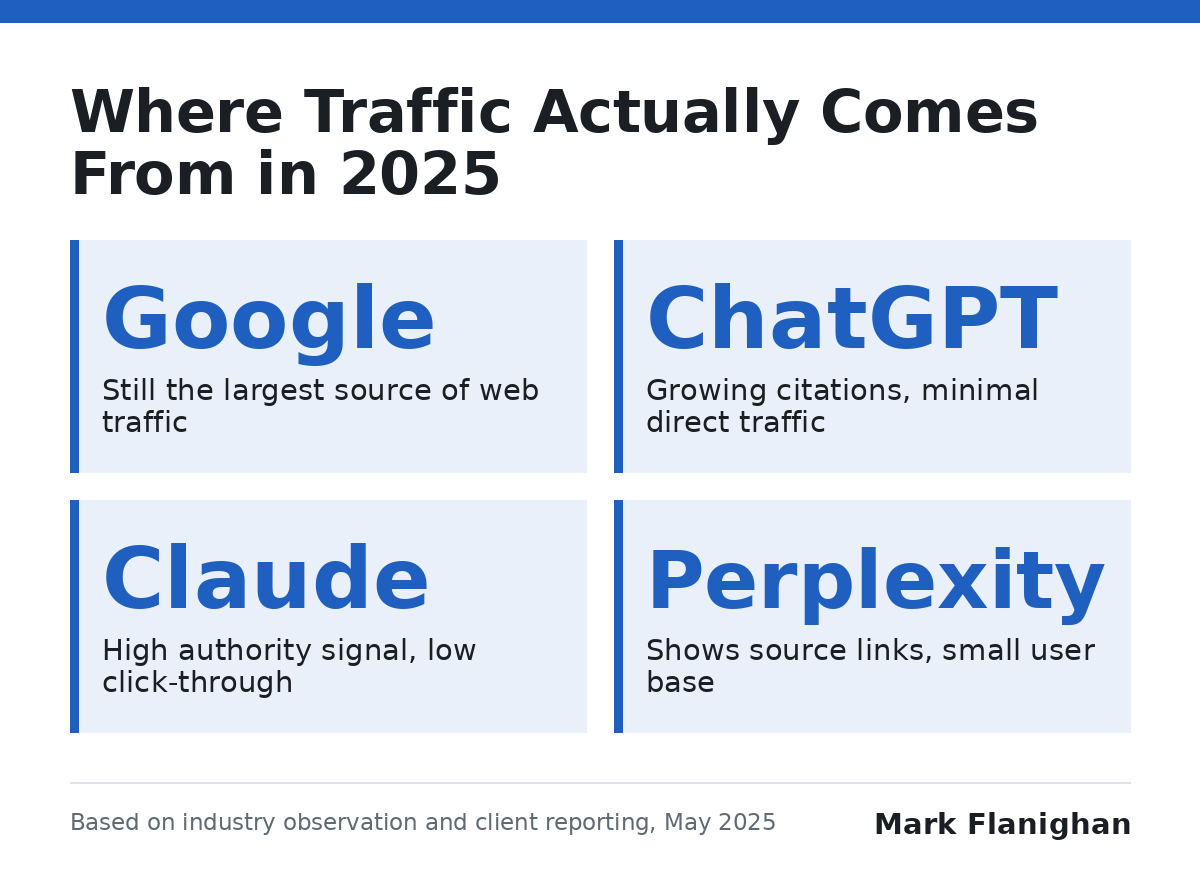
There is no doubt being found on ChatGPT, Gemini or Claude will help your business profile — it's a very useful citation. But don't kid yourself it will deliver traffic. Well, not yet anyway.
AI tools typically synthesise an answer and cite sources as attribution, not as a clickable destination. Some systems (Perplexity, for example) do show source links, and a small number of users click through. But the volume is a fraction of what traditional search delivers.
Where the value is today
The value today is in authority and reach, not in direct traffic. When an AI model cites your business by name, that builds recognition and trust, and it helps people find you for your brand name. It positions you as a credible source in your field. Over time, that reputation feeds back into search rankings, referrals, and word-of-mouth.
Promises to be wary of
If someone promises you "hundreds of new visitors a week from AEO," treat it the same way you'd treat promises of overnight ranking on Google: with scepticism. Genuine results take time, as I explain in how long SEO takes.
What makes content visible to AI systems?
The good news: the fundamentals haven't changed. AI systems favour the same qualities that good SEO content strategy has always rewarded, and the same things Google rewards in authority content.
- Answer the question in the first paragraph. AI models scan for direct, plain answers. If your opening paragraph dances around the subject or buries the answer three sections down, the model moves on.
- Use specific, verifiable facts. Named regulations, cited figures, real examples. General statements get ignored. Concrete details get quoted.
- Structure for scanning. Headings phrased as questions. Tables, lists, short paragraphs. AI systems parse structure the same way a time-pressed human does.
- Cite your sources. If you reference a study, a law, or a threshold, name it. Attribution signals credibility.
- Include one quotable line. A clear opinion or insight, attributed by name. The kind of sentence a journalist — or an AI — would lift.
AI Optimisation Checklist for Your Content
0 of 8 done
| Content Element | Why It Matters | Done | Notes |
|---|---|---|---|
| Answer in first paragraph | AI scans opening text for direct answers | ||
| At least 3 verifiable facts | Concrete details get cited over general claims | ||
| Headings as questions | Matches how people ask AI systems | ||
| Table or numbered list | Structured data easier for AI to parse | ||
| One quotable sentence | Attributed insight AI can lift | ||
| Source citations | Builds credibility signal | ||
| Clear next step | Practical value for the reader | ||
| Last updated date | Signals current information |
Complete each row for one key page, then repeat for other priority content.
These principles apply whether you call it AEO, GEO, AIO, LLMO, or just authoritative content writing.
Should you hire someone who specialises in these acronyms?
What to ask them
Possibly, but ask what they actually do differently.
If the answer involves structured data markup, clear headings, factual precision, and content that answers questions — that's sound practice, whatever they call it. If they claim proprietary techniques or guaranteed AI visibility, walk away.
The risk of chasing acronyms
The risk with trendy acronyms is that they distract from the fundamentals. A business chasing "LLMO" while ignoring search intent, page speed, or internal linking is solving the wrong problem. A regular website audit shows where those gaps are.
Good content strategy already accounts for how people find and use information, whether through Google, an AI chat, a voice assistant, or a link from a colleague. The format changes; the principles don't.
What should you actually focus on?
Forget the acronyms. Focus on being the most useful, most specific source in your niche.
That means:
- Writing for the question your customer actually asks, not the one you wish they'd ask.
- Providing facts, figures, and examples no one else has, because they come from your own work.
- Structuring content so a reader (or an AI) can pull the answer in seconds.
- Building authority over time, not chasing quick wins. Turning blog posts into authority assets is a good place to start.
If you do that consistently, you'll be found — by Google, by AI systems, and by the people who matter to your business.
The delivery mechanism changes. The need for clear, credible, useful content does not.
One practical step you can take this week
Pick one question your customers ask regularly. Write a 400-word answer that includes at least three checkable facts: a named standard, a figure with a source, a real example. Structure it with the answer in the first paragraph and a table or list for any steps or options.
Publish it. Then see where it gets cited.
If you'd rather have someone handle content strategy and writing that works across every channel — search, AI, social, and everything in between — let's talk.
Last updated: 12 November 2026, correct at the date above.