
When you need a plumber, a solicitor, or a marketing consultant, what's the first thing you do? You Google it. And when those search results pop up, you're not just looking for a service; you're looking for a sign. A sign that this business knows their stuff, that they've helped people like you, and that you can trust them with your problem (and your money).
For businesses in Middlesbrough and beyond, this moment of decision is everything. As one local business owner put it: "If you are a Middlesbrough based business, how your clients see you is defined by trust and authority. Your blog posts will define your authority on the subject, either good or bad, so don't just rely on sales pages, or quickly written social media posts."
This is the golden rule. Your content isn't just filler for your website—it's the foundational layer of your reputation. In this post, we’ll explore how to stop writing mere blog posts and start building "Authority Assets" that turn casual browsers into loyal clients.
The Trust Gap: Why "Just Posting" Isn't Enough Anymore
We live in the age of information saturation. A quick social media post might get a like, and a sales page makes a promise, but neither consistently builds the deep trust required for someone to choose you over a competitor. This is the trust gap.
Think of it this way:
- A Sales Page: Says, "We are great. Hire us."
- A Social Media Post: Says, "Look at this quick tip or cool thing we did!"
- An Authority Asset (a transformed blog post): Says, "We understand the problem you're facing. Here is a comprehensive, helpful guide that proves our expertise and shows you how to think about solving it."
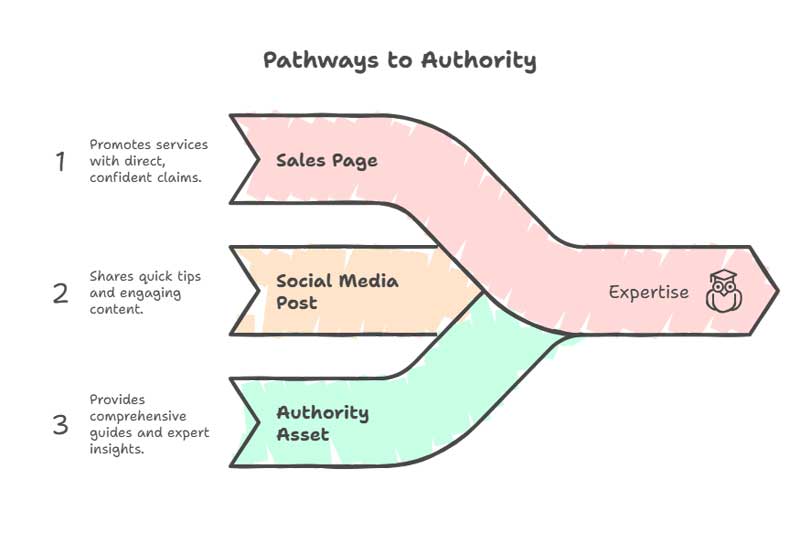
The first two are transactional. The last one is relational. It provides value before asking for anything in return. According to a pivotal study by the Content Marketing Institute, educational content that addresses a customer's pain points early in their journey is critical for building the trust needed for later-stage sales conversations. They’re not just reading; they’re evaluating your competence and character.
Blog Post vs. Authority Asset: What's the Real Difference?
It’s all about intent and execution. A blog post is often a single piece of information. An Authority Asset is a strategic, trust-building tool.
Let’s break it down:
| Feature | The Standard Blog Post | The Authority Asset |
|---|---|---|
| Primary Goal | To publish content, often for SEO "keywords." | To solve a problem comprehensively and build trust. |
| Research Depth | Surface-level, often summarizing other articles. | Original insights, data, case studies, or unique synthesis. |
| Reader Takeaway | "That was an okay read." | "Wow, this company really gets it. I should bookmark this/send it to my colleague/contact them." |
| Longevity | May become outdated quickly. | Acts as a lasting, evergreen resource that draws traffic for years. |
| Conversion Path | Weak or non-existent. | Gently guides the reader to a next logical step (a deeper guide, a consultation, a related service). |
An Authority Asset is what happens when you take a topic crucial to your ideal client and own it so thoroughly that your article becomes the go-to resource. For a Middlesbrough financial advisor, it’s not “5 Savings Tips,” but “A Complete Guide to Navigating Inheritance Tax for Teesside Homeowners.” For a B2B IT firm, it’s not “Why Cybersecurity Matters,” but “The 2024 Roadmap for Cyber Resilience in North East Manufacturing.”
The Alchemy: How to Transform Content into a Trust Signal
So, how do you perform this transformation? It’s a shift in mindset and process.
1. Start with Deep, Empathetic Research (Before You Write a Word)
This is where most posts fail. Go beyond keyword tools. What are your clients really asking? Use forums like Reddit, scour Quora, listen to sales call recordings, and talk to your customer-facing team. What keeps them up at night? A tool like AnswerThePublic can be fantastic for visualizing the real questions people ask around a topic. When you write from this place of empathy, your content resonates on a different level. It signals, "We listen."
2. Aim for Comprehensive Clarity, Not Just Content
Your goal should be to create the most helpful, clear, and useful piece on the internet for that specific problem. This often means creating long-form, pillar content. A study by Backlinko analyzing over 11 million search results found a clear correlation between content depth (word count) and higher search engine rankings, which often reflects searcher satisfaction. Don’t write for the count; write until the topic is thoroughly addressed. Use clear headings, subheadings, and a logical flow that guides someone from confusion to understanding.
3. Weave in Proof and Credibility
Trust needs evidence. This is where you seamlessly integrate your references and proof points.
- Link to authoritative sources: Cite industry reports, respected publications, or local statistics (think Tees Valley Combined Authority for local economic insights). This shows your work is grounded in reality.
- Showcase client stories (with permission): A brief, relatable case study is worth a thousand sales claims. "How we helped a Middlesbrough retailer reduce overheads by 15%" is powerful.
- Demonstrate process: Don’t just state you’re experts; show your thinking. Explain why a certain approach works, the pros and cons, and the nuances.
4. Design for the Reader’s Journey
An Authority Asset is a guided experience.
- Introduction that hooks with a relatable problem: "Struggling with rising energy costs at your Stockton warehouse? You're not alone..."
- Body that educates and empowers: Use H2 and H3 tags to break down the solution into digestible steps.
- Conclusion that offers a logical next step: After providing immense value, it’s natural to say, “If implementing this feels overwhelming, our team specialises in turning these plans into action. Here’s how we can help.” This feels helpful, not pushy.
The Tangible Benefits: What Authority Assets Do for Your Business
When you make this shift, the effects ripple through your entire business:
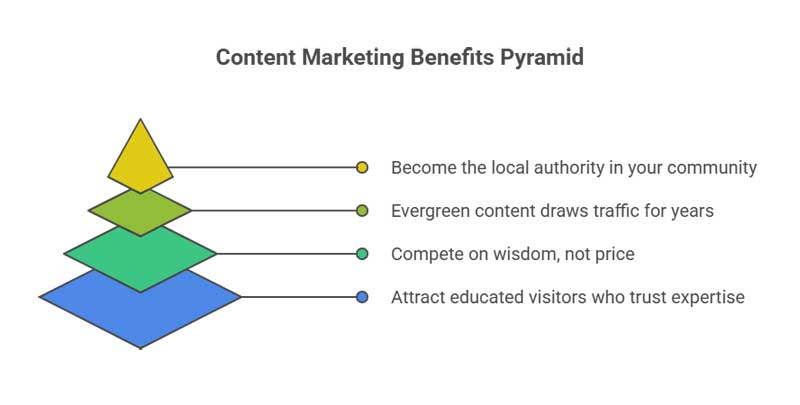
- Higher Quality Leads: You attract visitors who are already educated and trust your expertise. The sales conversation starts at a much more advanced, productive stage.
- Competitive Insulation: It’s very hard to compete with a business that has become the acknowledged thought leader on key topics through its content. You’re not competing on price; you’re competing on wisdom.
- Sustainable Organic Growth: These cornerstone assets draw consistent traffic for years, building a library of trust that works for you 24/7. As Search Engine Journal notes, evergreen content forms the stable core of a high-performing SEO strategy, attracting links and rankings long after publication.
- Enhanced Local Reputation: For a Middlesbrough business, this is key. By deeply addressing local issues, regulations, or market conditions, you become the obvious expert in your community. You’re not just another service; you’re the Teesside authority.
Your Next Step: Audit and Elevate
Take a look at your blog today. Which posts have the most potential to be expanded into true Authority Assets? Choose one. Apply the principles above:
- Deepen the research.
- Update it with the latest data and examples.
- Structure it as the ultimate guide.
- Add clear, helpful calls-to-action.
Don't just tell people you're an authority. Build the assets that prove it. In a digital world where trust is the ultimate currency, your content is your most powerful mint. Start investing in it accordingly.
When you do, you’ll find that what you’re really building isn’t just a better blog—it’s a more resilient, respected, and trusted business. And for any business, whether in Middlesbrough, Stockton on Tees, or Billingham, that’s the only asset that truly lasts.
Maybe I Can Do This For You? Let's Talk Content, Teesside
If everything we've just discussed makes sense but also feels a bit daunting—like adding another huge project to your already overflowing to-do list—I get it. You're running a business. Your expertise lies in your trade, your service, or your product, not in crafting 2,000-word strategic guides. That's exactly where I come in.
Hi, I'm Mark Flanighan, a content writer based right here in Teesside. My entire focus is helping local businesses like yours bridge that trust gap we talked about. I don't just write words for search engines; I build Authority Assets that speak directly to your ideal clients in Middlesbrough, Stockton, Redcar, and across the North East.
Think of me as your outsourced authority-engine. My process is simple:
- We Talk: We’ll have a cuppa (virtual or in-person) and I’ll dig into your world—your clients' biggest headaches, your unique insights, and the stories only you can tell.
- I Strategise & Research: I’ll find the topics where your expertise can shine brightest and map out content that answers real questions, not just ticks keyword boxes. I know how to find the local data and angles that make your content genuinely relevant.
- I Craft & Deliver: You’ll receive content that’s more than a blog post. It’s a strategically designed trust signal, written in a clear, engaging voice that reflects your business values. It will be structured to guide readers, demonstrate your know-how, and positioned to work for you for years to come.
I'm not a faceless agency. I'm your neighbour. I understand the character of our region, the specific opportunities and challenges facing Teesside businesses, and the local pride that fuels what we do. I want your website to be a destination that people bookmark because they know they’ll find genuine, valuable insight.
Turning your knowledge into compelling, trust-building content shouldn't be a source of stress. It should be your most reliable marketing engine. If you’re ready to transform your online presence from a digital brochure into a portfolio of authoritative assets, let's talk.
You can reach out to me directly through my website or LinkedIn to start the conversation. Let's make your expertise impossible to ignore.