
When you think about your business’s credibility, what comes to mind? Is it your glowing customer reviews? Your professional certifications? The quality of your product? All of those are vital, absolutely. But there’s a silent, slow-burning threat that many businesses never see coming: their own content.
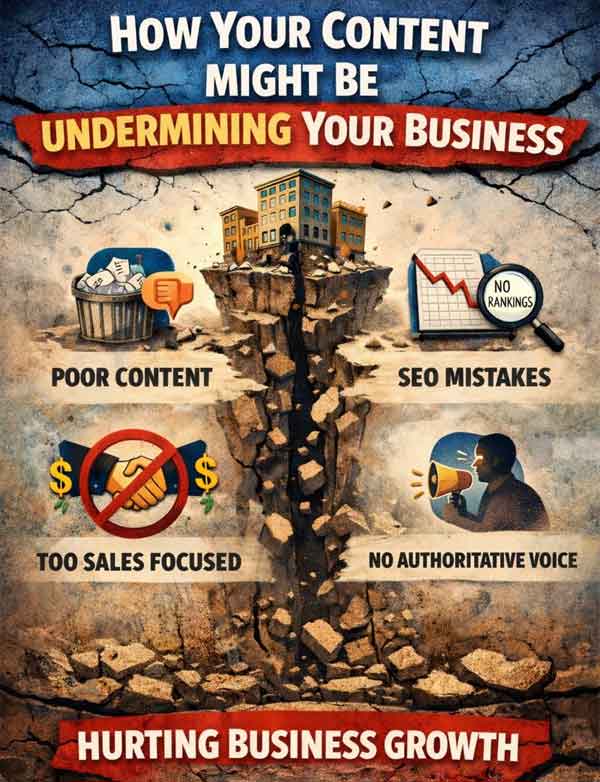
I’m talking about the blog posts filled with jargon, that says everything and nothing at all or worse, "boiler plate text". This isn’t just about aesthetics; it’s about foundation. Poorly written content that fails to impress trust and authority is like having a crack in your shop window. People might still come in, but they’ll wonder about the stability of the whole building.
As a content writer based in Teesside, I’ve seen firsthand how local businesses can transform their online presence by swapping out weak, inconsistent content for clear, authoritative writing. This isn't just about sounding fancy—it’s about building an asset that boosts Google visibility and, most importantly, earns genuine trust with customers.
The Unseen Erosion: How Bad Content Breaks Trust
You don’t usually get an email saying, “Hello, your comma splices made me doubt your expertise.” The process is far more insidious. According to a Stanford Web Credibility Project finding, 75% of users judge a company’s credibility based on the design and writing quality of its website. The assessment is instantaneous and often subconscious.
Think about your own browsing habits. You click a link from a Google search, hoping to solve a problem. The page is a wall of text, riddled with spelling mistakes like “profesional” and “impresss.” The tone is either aggressively salesy or depressingly vague. How long do you stay? You hit the back button. In that moment, the business didn’t just lose a visitor; it lost a potential believer. A study on perceived credibility found that simple errors in spelling and grammar can significantly reduce a website's perceived trustworthiness.
Authority vs. Ambiguity: What Your Content Really Says
Let’s break down the key differences. Authoritative content isn’t about using the biggest words; it’s about demonstrating clarity, confidence, and deep understanding of your customer’s needs.
| Content That Builds Credibility | Content That Erodes Credibility |
|---|---|
| Clear, Customer-Focused Language: Speaks directly to the reader’s problems and goals. | Vague, Jargon-Filled Claims: Uses phrases like “best-in-class solutions” without explanation. |
| Flawless Execution: Meticulous proofreading for spelling, grammar, and flow. | Frequent Typos & Errors: Signals carelessness (e.g., “We are committed to exellent service”). |
| Substance Over Hype: Provides actionable insights, data, and useful information. | Empty Promises: All sizzle, no steak—lots of “we’re the best” but no why. |
| Consistent Voice & Branding: Feels recognisable and reliable across all platforms. | Inconsistent Messaging: The website says one thing, social media says another. |
| Answered Questions: Anticipates and addresses customer doubts directly. | Ignored Objections: Fails to tackle common concerns about price, quality, or process. |
The right-hand column isn’t a caricature; it’s the daily reality of countless business websites. And the dynamic is simple: ambiguity breeds distrust. If you can’t clearly articulate what you do and why it matters, why should a customer believe you can do it well?
The Ripple Effect: SEO, Visibility, and the Trust Loop
Here’s where it gets even more critical for your bottom line. Google’s algorithms have evolved far beyond simple keyword matching. They now prioritise E-E-A-T (Experience, Expertise, Authoritativeness, and Trustworthiness). Google’s very own Search Quality Guidelines emphasise the importance of these factors. In plain English? Google wants to rank content written by experts who know their stuff and are considered a trustworthy source.
So, when you publish thin, error-ridden, or generic content:
- Users bounce back to search results quickly (a high “bounce rate”), signalling to Google that your page wasn’t helpful.
- Other reputable sites don’t link to you, because your content isn’t seen as a valuable resource.
- Your domain authority stagnates, keeping you stuck on page two (or three, or four) of search results.
Conversely, authoritative content creates a virtuous cycle. Great content earns links, engages visitors, and satisfies both users and search engines. This improves your rankings, which brings more visibility, which brings more customers who see you as the obvious expert—further cementing your credibility. It’s a self-reinforcing loop of trust and growth.
From Teesside to the Digital World: Making It Local and Real
For local businesses here in Teesside—from a Middlesbrough solicitor to a Stockton bakery or a Redcar tradesperson—this is your golden opportunity. Local SEO thrives on specificity and community connection. Authoritative local content isn't just about “plumbing services”; it’s about a blog post titled “A Guide to Preventing Common Winter Pipe Issues in Victorian Homes in Norton.” See the difference?
That kind of content shows deep local knowledge. It uses the right place names, understands local architecture, and speaks to specific community concerns. It proves you’re not a faceless national franchise; you’re a neighbour who gets it. This hyper-relevant authority is incredibly powerful for both Google rankings and winning over the community. It’s how you turn a generic search into a local connection.
Rebuilding the Foundation: Your Path to Credible Content
The good news? This is all fixable. Turning your content from a liability into your strongest asset starts with a mindset shift. View every piece of content—from a tweet to a flagship guide—as a brick in your brand’s house of trust.
Start with an audit. Read your website out loud. Does it sound like something a real person would say to a customer? Check for those typos. Ask a brutally honest friend or a customer what they think your business does after reading your homepage.
Then, commit to a strategy of depth over breadth. Instead of churning out 15 mediocre blogs a month, create four great guides and authoritative blog posts that becomes the go-to resource for your niche. Update your service pages with clear, benefit-driven language that addresses “what’s in it for me?” at every turn.
If writing isn’t your strength or you simply don’t have the time (and let’s face it, most business owners don’t), that’s where a professional can be invaluable. A skilled content writer acts as your translator, taking your deep expertise and presenting it in a way that builds trust with your audience. They handle the nuances of SEO, the flow of engagement, and the polish of professionalism, so you can focus on running your business.
My Final Words Of Wisdom
Credibility is hard to earn and terrifyingly easy to lose. In a world where your digital content is often the first—and sometimes only—impression you make, leaving it to chance is a risk no business can afford.
The investment in clear, authoritative, and helpful content is an investment in the very perception of your business. It tells search engines you’re a leader worth ranking and tells customers you’re a partner worth trusting. It’s the difference between being just another option and being the obvious, reliable choice.
So, take a look at your content today. Is it building you up, or is it quietly holding you back? The path to greater trust, better visibility, and stronger customer relationships starts with the very next word you publish.