
Have you ever read a blog post that felt like it was written by a robot? You know the type—it answers a question you searched for, but the writing is stiff, the advice is generic, and you finish it feeling more confused than when you started. You didn't bookmark it. You certainly didn't share it. And you probably didn't trust the brand behind it.
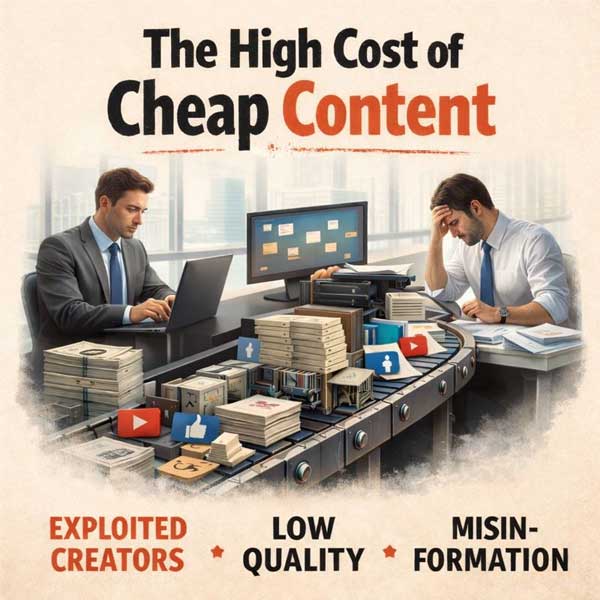
This is the stark reality of cheap, mass-produced content. In a rush to fill websites and chase SEO trends, many businesses end up with a digital graveyard of articles that no human loves and Google increasingly ignores. The alternative isn't just "more expensive" content; it's a fundamentally different approach focused on building authority and trust.
Today, the digital landscape is ruthlessly separating the two. Google's algorithms now actively seek out and reward what they term "helpful content"—content created for people first, which demonstrates real expertise. Meanwhile, customers are savvier than ever; they can spot a shallow, salesy article from a mile away and will bounce from your site in seconds if they don't feel they can trust you.
This post will break down the crucial difference between content that's just there and content that actively builds a foundation of trust for your business. We’ll look at why this shift matters more than ever, and how you can start creating content that not only ranks but also creates lasting relationships with your audience.
The Trust Economy: Why Your Content Can't Afford to Be Generic
We live in what's often called the "trust economy." Before making a purchase, signing up for a service, or even subscribing to a newsletter, people conduct deep research. They read reviews, watch comparison videos, and dig through blog archives. They're not just looking for a product feature list; they're looking for proof that you understand their problem.
This is where authoritative content shines. It’s not your social media post about a company picnic (though that has its place), and it’s not a hard-sell landing page screaming "BUY NOW!" It's the substantial, in-depth material that forms the bedrock of your site. As highlighted by content strategists, this is E-E-A-T content—it showcases your Experience, Expertise, Authoritativeness, and Trustworthiness.
Think of it this way: your social content is the friendly chatter at a party, your sales pages are the final pitch, but your authoritative content is the thoughtful, evidence-based conversation that proves you're the most knowledgeable person in the room. It’s what turns a casual visitor into a believing prospect.
The demand for this quality is skyrocketing, especially for small and medium businesses. In a competitive market, you can't out-shout the giants with a bigger ad budget. But you can out-teach, out-explain, and out-trust them by demonstrating genuine expertise on your own website. This is why you should always consider an authoritative content writer, when looking for freelancer.
Side-by-Side: Cheap Content vs. Trust-Building Content
Let's make this practical. The table below breaks down the fundamental differences between these two approaches. It's not about budget alone; it's about philosophy, process, and result.
| Feature | Cheap, Transactional Content | Trust-Building, Authoritative Content |
|---|---|---|
| Primary Goal | To quickly rank for a keyword or fill a content calendar. | To educate, build long-term authority, and earn customer trust. |
| Research Depth | Surface-level, often rewriting top search results. | Deep, starting with a unique "why" from the business and investigating credible sources. |
| Creation Process | Often fully automated or hastily written by generalists. | A human-guided process where tools assist, but an expert writer sculpts the final piece. |
| Voice & Tone | Generic, robotic, and prone to exaggerated claims. | Natural, conversational, and aligned with the brand's unique perspective. |
| SEO Approach | Keyword stuffing and chasing short-term algorithm tricks. | Creating comprehensive answers that satisfy user intent and align with E-E-A-T principles. |
| Visual Strategy | Stock photos or none at all. | Custom visuals, infographics, and embedded multimedia to enhance understanding. |
| Longevity | Becomes outdated quickly and offers diminishing returns. | Serves as a durable, evergreen asset that attracts traffic and leads for years. |
| Conversion Path | Relies on aggressive, immediate calls-to-action. | Nurtures the reader and uses subtle, contextual CTAs that feel like a natural next step. |
As you can see, the gap is significant. One is a cost, the other is an investment. One is designed to be consumed once, the other is built to become a permanent, valuable resource on your site.
The Anatomy of Content That Builds Trust: A Proven Process
So, how do you create the content in the right column? It's not a mystery, but it does require a disciplined, strategic approach. Based on proven methods for creating authoritative web content, here’s a breakdown of the essential steps.
Start with the "Why," Not Just the "What"
The most critical mistake is starting with just a keyword. A brief that says "write 800 words about project management software" is a recipe for generic content. The process must begin with a foundational sentence that provides unique context. For example: "Our project management software was designed for remote creative agencies because we found traditional tools over-complicated the feedback loop on visual assets."
This "why" becomes the compass for the entire piece. It ensures the content is rooted in your business’s genuine differentiators and speaks directly to the nuanced problems of your ideal customer.
Leverage Tools Intelligently, Then Apply the Human Touch
Modern tools can accelerate the initial phase. AI can act as a powerful research assistant, helping to gather information and form a coherent first draft on complex topics far faster than starting from a blank page.
However, the crucial insight is this: the AI is the rough draft writer, not the author. This is where the real work begins. A skilled writer must then:
- Rewrite for Natural Flow: Every robotic or generic sentence is hand-crafted to sound like a real expert explaining a concept.
- Craft Powerful Headers: Transform bland subtitles into compelling, scannable guides that lead the reader through a logical argument.
- Ensure Originality: The final piece must pass stringent plagiarism checks. Originality is non-negotiable for credibility and SEO.
Build Authority Beyond the Text
Trust isn't built by words alone. People process visuals exponentially faster than text. Authoritative content invests in this by:
- Using Custom Images: Creating 2-3 unique visuals per article (featured images, infographics) that incorporate brand elements.
- Embedding Multimedia: Seamlessly adding relevant tutorial videos or podcasts to increase engagement and dwell time.
- Smart Linking: Building a web of credibility by linking internally to other site resources and externally to respected industry sources, reports, and publications.
Optimise for Both Humans and Search Engines
The final step is seamless integration. This means not just delivering a document, but providing:
- Compelling Titles & Meta Descriptions: Crafting the snippet that appears in search results to maximise click-through rates.
- Ready-to-Publish Formatting: For many clients, the content can be delivered formatted and ready to go in their CMS (like WordPress), complete with images and links.
The Real-World Impact: More Than Just Rankings
Choosing to invest in trust-building content isn't just an SEO tactic; it's a business growth strategy with tangible outcomes.
First, it aligns perfectly with where Google is going. Updates like the "Helpful Content Update" are specifically designed to surface content created for people, by experts. Thin, AI-generated pages without human oversight are being systematically demoted. By focusing on E-E-A-T, you future-proof your site against these shifts.
Second, it generates higher-quality leads. A study by the Nielsen Norman Group on how users engage with detailed content confirms that people spend significant time with trustworthy, in-depth material when making decisions. When a visitor reads your comprehensive guide and then clicks your "Learn More About Our Service" link, they are already warm, informed, and primed to trust you. This leads to better conversion rates and higher customer lifetime value.
Finally, it creates sustainable efficiency. For small businesses, hiring a full-time, senior-level writer is a major commitment. Working with a specialist freelance writer who understands this authoritative model offers expert, on-demand results without the overhead. They become a strategic partner in building your online reputation.
Making the Shift: Your Next Steps
The gap between cheap content and trust-building content is wide, but crossing it is straightforward. It starts with a change in perspective.
- Audit Your Existing Content. Look at your top blog posts or service pages. Do they simply describe what you do, or do they deeply explain why you do it and how you solve problems differently? Be ruthless.
- Plan Your Next Piece Around a "Seed of Expertise." Before you or a writer starts typing, articulate that one core, unique insight your business has. Make that the central pillar of the article.
- Prioritise Depth Over Frequency. It's better to publish one phenomenal, comprehensive guide per month than four shallow posts that nobody remembers. Quality compounds over time.
- Seek a Partner, Not Just a Writer. If you're looking for external help, look for someone who talks about process, strategy, and E-E-A-T—not just word count and turnaround time. Look for a freelance authoritative content writer who asks "why" before "what."
Building trust through content is the slow-burn strategy that wins the race. In a world saturated with noise, being a clear, reliable, and helpful voice is the most powerful competitive advantage you can have. It’s the content that doesn't just attract clicks—it builds a community and a business that lasts.