
I have been in the SEO business for decades and I have to admit, keeping website up to date, has been a real problem, when I have been focused on so many others. Keeping a website fed with fresh, engaging, and Google-loving content is a marathon. As a business owner, marketer, or fellow writer in the UK, you’ve probably felt the pinch also. You need content that ranks, but you also need it to sound like a human wrote it—someone who understands your local audience in Teesside, London, or Edinburgh. That’s where my process comes in, and it might just be the game-changer you're looking for.
It is also very important that the data within your website, shows Authority to Google. In better words, "do you know your stuff". Authoritative content is in my view one of the most important aspects of SEO.
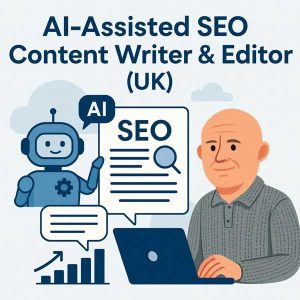
I don’t just use AI or rely solely on my own brain. I combine them. Think of it as a powerful research assistant handing me a diamond in the rough, and me, the expert jeweller, cutting and polishing it until it shines. Here’s my honest, no-fluff breakdown of how an AI-Assisted SEO Content Writer & Editor in the UK really works.
Why AI Alone Isn't Your SEO Saviour (Especially in the UK)
First, let's clear something up. AI writing tools are incredible, but they are not a magic "rank #1" button. Google’s algorithms, particularly helpful content updates, are smarter than ever at spotting low-value, generic text. Their E-E-A-T framework (Experience, Expertise, Authoritativeness, Trustworthiness) is all about human value.
An AI, trained on vast global data, might not instinctively know that "pants" in the UK are trousers, not underwear, (that phrase could also mean "rubbish") or that a "FTSE 250 company" is a more relevant reference point for a UK business audience than a "S&P 500" one. It might miss the nuanced cultural references that make a piece truly connect.
My role starts by directing the AI with precision. I use it as a supreme research tool.
Need the latest statistics on remote work trends in the UK?
The AI can scour reports from Chartered Institute of Personnel and Development (CIPD) or the Office for National Statistics (ONS) in seconds. Looking for the best practices for local SEO in Teesside? It can collate guidelines from Google's Search Central and insights from leading UK SEO agencies.
This phase is about gathering accurate, up-to-date, and credible information at speed. But what I get is raw material—comprehensive, but lacking a unique voice, a strategic SEO structure, and that crucial human perspective.
The Human Touch: Where the Magic Happens
This is where I roll up my sleeves. The AI-generated draft is my foundation, but the building is entirely mine. My editing process is a multi-layered approach designed to inject quality, personality, and search intent.
1. SEO Surgery & Structure:
I analyse the target keywords (naturally, including location-based ones like "SEO services Bristol") and ensure they are placed strategically—in the H1, maybe H2s, the meta description, and the URL. But I never keyword-stuff. I then look at the content structure. Does it answer the user's question logically? The key here is now less is more.
2. The Personality Transplant:
This is the biggest step. I rewrite sentences to sound conversational where it is needed. I add anecdotes, relatable UK-specific examples (like referencing the "cost of living crisis" impact on consumer behaviour (notice UK spelling)), and a tone that matches your brand—whether that’s professional and authoritative or friendly and cheeky. I cut out the robotic fluff and ensure every paragraph drives a point home. Sometimes there a British terms not used within an AI format.
3. The Final Polish:
I read the piece aloud. Does it flow? Are there any jarring transitions? This is where I catch awkward phrasing and ensure the entire article is an easy, enjoyable read from start to finish.
AI vs. Human vs. The Hybrid: A Clear Comparison
Let’s break down the differences visually. This table shows why the hybrid model isn't just a compromise—it's the optimal balance.
| Feature | Pure AI-Generated Content | Traditional Human-Only Writing | AI-Assisted Human Editing (My Process) |
|---|---|---|---|
| Research Speed & Depth | Extremely Fast, Broad | Slow, Manual | Very Fast & Comprehensive (AI-powered) |
| SEO Technical Accuracy | Often Generic, Can Be Misapplied | High (If Writer is Skilled) | High & Strategic (Human-optimised) |
| Brand Voice & Uniqueness | Low, Generic Tone | High, Unique | High, On-Brand & Unique (Human-crafted) |
| Understanding Local Nuance | Poor (Without Heavy Prompting) | High | High (UK-based human insight) |
| Cost & Scalability | Low Cost, Highly Scalable | High Cost, Slower to Scale | Optimised Value, Scalable |
| E-E-A-T Signals | Weak | Strong | Strong & Verifiable |
As you can see, the hybrid approach aims to take the best of both worlds: the efficiency and data-processing power of AI, coupled with the strategic, creative, and empathetic intelligence of a human expert.
The Tangible Benefits for Your UK Business
So, what does this process actually deliver for your website?
-
Ranking for the Right Terms: By combining AI's data aggregation with my SEO knowledge, we target keywords with intent. We don’t just chase high-volume terms; we find phrases your ideal customers in Leeds or Glasgow are actually searching for.
-
Creating Authority: Most websites, need more authoritative web content than sales pages. The best sales pages, tend to sell the benefits or features of a product or service and need to be to the point, in order to get that conversion. This "to the point", sometimes does not show an authority of the subject, so the solution is to support these sales pages with authoritative content pages.
-
Staying Ahead of the Curve: Google's algorithms change. Best practices evolve. My process is adaptable. I use AI to help track these changes and then apply the understanding of them to your content strategy.
Is This the Future of Content Creation?
In my view, absolutely. The conversation is shifting from "AI vs. Human" to "Human + AI." The tools are here to augment our capabilities, not replace the nuance, creativity, and strategic thinking that a skilled writer brings to the table. Google does not mind AI where it is used correctly. In fact Google is at the forefront of AI, it is when nothing new or useful is created through AI, that content is downgraded.
For UK businesses, this is particularly powerful. We’re operating in a competitive, sophisticated digital landscape. To stand out, you need content that is not only optimised for algorithms but also resonates on a human level with your local audience.
The goal isn’t to hide the use of AI; it’s to use it ethically and intelligently to produce a superior end product. It’s about working smarter, not just harder. Hence the term "AI-assisted content writer", rather than just copy and paste from ChatGPT (which by the way I do not use for the written word).
Ready to see the difference a hybrid approach can make? If you’re tired of generic content or struggling to keep up with your blog’s demands, let’s talk. I can help you create SEO-strong, genuinely engaging content that speaks directly to your audience and helps your business grow.