
Let’s rewind to a couple of months ago. I was positive, about the future of my freelance writing business. Like many of us, I’d integrated AI tools into my workflow. I was using them for brainstorming, beating the blank page, and refining drafts—all while applying my years of editorial experience to ensure the final output was strategic, human, and effective.
I needed a way to communicate this hybrid value to potential clients. “Writer” felt too broad. “Copywriter” didn’t quite capture the tech-forward angle. So, I landed on what I thought was a clever solution: I would market myself as an “AI-Assisted Content Writer.”
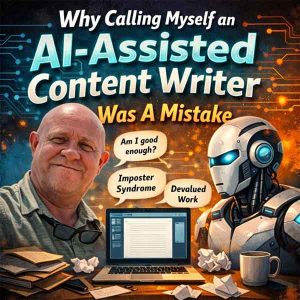
It made perfect sense! It was accurate, modern, and clearly stated what I did. I updated my website, my LinkedIn profile, and even penned a service page explaining my process. I sat back, sure I had made the right business strategy.
But—when I did check my site’s analytics and then checked my Google rankings, it was all laughable. Only then, did I finally do the one thing I should have done at the very beginning:
Research the keyword “AI Assisted Content Writer” like an SEO.
That’s when the painful, forehead-slapping truth hit me.
The Keyword Blunder I Should Have Understood Before I Started
My research revealed a brutal reality. I wasn’t competing with other freelance writers or small agencies. By using that term, I had unknowingly thrown myself into the ring with tech giants.
The top search results for “AI assisted content writer” were (and still are) dominated by platforms like Jasper, Writesonic, and Copy.ai. These are multi-million dollar companies with massive SEO budgets. My little service page, no matter how well-optimized, stood zero chance of ranking on the first page of Google for that term. A quick look at the search engine results pages (SERPs) shows the landscape is almost entirely product-focused, not service-provider focused.
The whole point of the original article was to find an SEO term that would be searchable by suitable clients, that reflected what I did with AI content. It was a mistake!
I had made a classic, yet embarrasing, error: I chose a keyword based on how I described myself to myself, not on how clients actually search for services. People looking to hire a person don’t typically search for “AI-assisted content writer.” They search for things like “content writer,” “SEO content specialist,” or “blog writer for [industry].” The people searching for the term I chose were largely looking to buy software, not hire a professional.
As one industry analyst noted, the confusion between AI tools and human expertise is a significant hurdle for freelancers in this space. We need to communicate the irreplaceable value we add beyond the tool itself.
The Human vs. The Tool: Why Language Matters
This experience forced me to think deeply about positioning. When you label yourself primarily by the tool you use, you inadvertently commoditize yourself. You become an extension of the software in the client’s mind.
My real value isn’t that I use AI. My value is in what I achieve with it:
-
Strategic Content Planning: Aligning content with business goals and audience needs.
-
Editorial Judgment: Knowing what tone, angle, and structure will truly resonate.
-
Fact-Checking & Expertise: AI is notorious for “hallucinating” facts. My job is to ensure everything is accurate and credible.
-
SEO Execution: Intelligently weaving keywords into narratives that people actually want to read, not robotic filler text.
-
Brand Voice Guardianship: Making sure every piece of content sounds uniquely “like” the client’s brand.
I needed a term that put these human skills front and center, with AI as the powerful sidekick in the process.
Finding the Right Label: A Comparison
After this debacle, I went back to the drawing board. I looked at what successful freelancers in my niche were calling themselves and analyzed the intent behind different search terms. The difference is stark:
| What I Called Myself (The Mistake) | What I Call Myself Now (The Solution) |
|---|---|
| AI-Assisted Content Writer | Authoritative Content Writer |
| Focuses on the tool (AI). | Focuses on trust and authority. |
| Competes with AI software platforms for visibility. | Competes with other professionals and agencies. |
| Implies the AI does the heavy lifting. | Implies I provide the strategy, insight, and final polish. |
| Attracts clients looking for a cheap, automated solution. | Attracts clients who value expertise and business results. |
This shift isn’t just semantic; it’s strategic. It moves the conversation from cost (how cheaply can you produce words?) to value (how can your content drive my business forward?).
The New Foundation: How I Communicate My Process Now
I haven’t hidden my use of AI. I’ve simply reframed it. On my website and in client conversations, I now lead with my human expertise. My services page clearly outlines my strategic process. Only later, in a section about “my toolkit” or “efficiency,” do I mention that I leverage cutting-edge AI tools to enhance research, overcome creative blocks, and deliver drafts faster—all under my expert guidance.
This approach immediately filters for better clients. It attracts businesses that understand content is an investment, not just a commodity. As highlighted in discussions about the future of creative work, the winners will be those who master the collaboration between human creativity and AI efficiency, not those who replace themselves with the tool.
My website copy now reads less like a software manual and more like a partnership proposal. The results speak for themselves: my client inquiries are more qualified, my projects are more engaging, and my position as an expert is stronger.
Lessons Learned for Your Own Brand
If you’re a writer, designer, or any kind of creative using AI, I urge you to learn from my expensive (in time and opportunity) mistake.
-
Research Keyword Intent Ruthlessly: Before you build a service around a term, type it into Google. Who’s ranking? Are they tools or people? What are the “people also ask” questions? Use tools like Google Keyword Planner or even free versions of Ahrefs or SEMrush to see search volume and competition.
-
Lead With Your Humanity, Not Your Toolset: You are not an AI operator. You are a strategist, a storyteller, a problem-solver who uses advanced tools. Frame your services around the transformations you provide.
-
Be Transparent, But Strategic: You can (and should) be open about your tech stack. But position AI as what it is—a powerful instrument in your orchestra, not the conductor. A great resource on this balance is Content Marketing Institute’s take on AI in content creation, which emphasizes the need for human oversight and strategy.
-
Target Client-Centric Keywords: Think about your ideal client’s pain points. They have a business problem (“we need more leads,” “our brand isn’t visible”). They search for solutions (“hire content writer for SaaS,” “SEO content agency”). Speak their language.
Calling myself an AI-Assisted Content Writer was a well-intentioned stumble. It put me in the wrong race entirely. By shifting my focus to the value I deliver as a human expert—a Content Strategist and Writer—I found my real audience.
The landscape is evolving fast, but one thing remains constant: clients hire people for their insight, their judgment, and their ability to connect. Don’t let a trendy label hide your true worth. Brand yourself for the work you want to do, not just the tool you use to do it. Your business will thank you for it.