
I’ve been testing SEO theories for over a decade, and CTR manipulation is one of those ideas that just keeps resurfacing—almost like a digital marketing urban legend. You hear whispers of massive ranking boosts from simple clicks, and you think: “Is it really that easy?”
So, like many SEOs chasing an edge, I decided to run a few experiments—not just one-off tests, but structured ones over different time frames, niches, and traffic manipulation methods.
Initial Tests with Bots and Emulators
My earliest experiments date back to when Google started using CTR as a factor in paid ads (Google Ads/Adsense). It made logical sense—if CTR affects ad performance and cost-per-click, maybe Google considers similar behavior signals in organic results.
So I tested it. I used several CTR manipulation tools—some emulators, some “traffic bots”—that promised to simulate clicks, dwell time, and even bounce behavior. The concept was simple: send “users” to your site, get them to stay a bit, and trick Google into thinking your site is gaining popularity.
The result?
Almost nothing.
If anything, some of my rankings dropped. And the quality of the traffic? Horrible. High bounce rates, no conversions, no meaningful time-on-site—even the best bots couldn’t convincingly fake human engagement. After a few days of testing one well-known bot, I actually saw a decrease in organic visibility and impressions. That test ended fast.
Micro-Workers: Real Humans, Real Costs
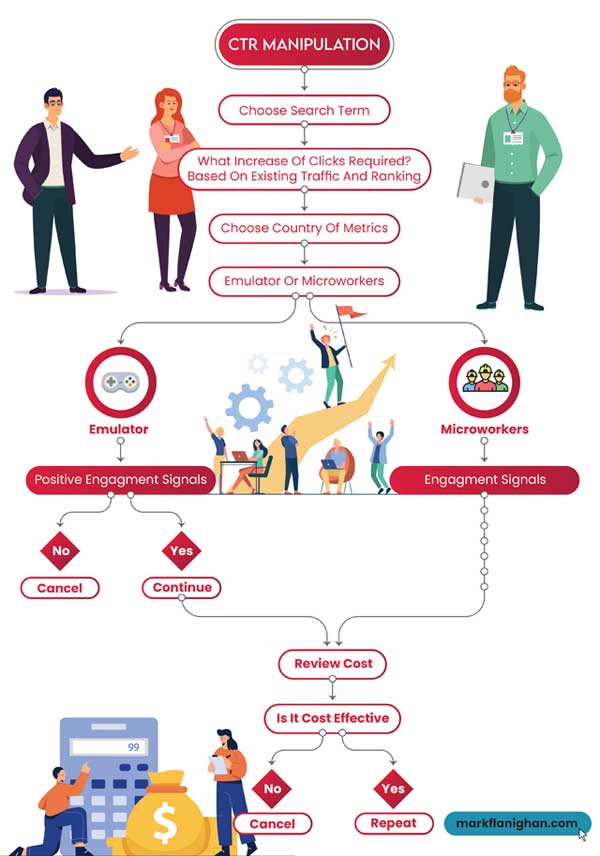
A few months later, I gave it another shot—this time using real people via a microworker platform. The idea was more promising: hire hundreds of workers to search a keyword, find my listing, click through, and spend a few minutes browsing. Some were even instructed to go to a second page, fill out a form, or click internal links.
And I’ll admit, I did see a small uptick in rankings for certain low-competition keywords. Positions 11–13 jumped into the top 10. In one local SEO campaign, we nudged a service page from position #5 to #3 within 10 days of launching the campaign.
But here’s the catch:
The effect was marginal, and it didn’t last long. As soon as we paused the microworker engagement, rankings slowly returned to their original spots. It was a temporary boost—like caffeine. You feel it, but it wears off quickly.
And the cost? Hiring hundreds of workers regularly isn’t cheap. For the same budget, I could have written three new content pages and picked up a handful of backlinks. Guess which one gave better long-term results?
VPNs and Device Farms: The Do-It-Yourself Approach
For the sake of completeness—and maybe curiosity—I also experimented with the more DIY approaches: multiple SIM cards, cheap Android phones, and VPNs.
I ran a test where I used 10 different devices, all on mobile data or VPNs. I varied browsers, cleared cookies, mimicked real user behavior—searching for a keyword, clicking on my site, navigating between pages, even staying for a few minutes.
The outcome?
Again, some slight movement. But it took a lot of effort for minimal gain. Rankings rose slightly, but the juice didn’t seem worth the squeeze. Plus, unless you scale this approach to dozens or hundreds of devices, you’ll barely register as a signal in Google’s eyes.
Is There Real Proof That CTR Manipulation Works?
Let’s address the big question: Can CTR manipulation directly cause your site to rank higher on Google?
The honest answer? Yes... but only under very specific conditions.
What Actually Moves the Needle
Through all my testing, I’ve come to a clear conclusion: CTR manipulation only works when paired with positive engagement signals.
In other words:
If someone clicks your listing and bounces immediately—Google sees that as a negative.
-
If they click through, scroll, visit other pages, or convert—Google sees that as a “satisfied” user.
So the click alone is never enough.
What actually worked best in my tests was when the traffic:
-
Came from different sources (search, social, direct)
-
Stayed on the site for 60+ seconds
-
Interacted with at least 2 pages
-
Sometimes submitted a form or watched a video
When I combined manipulated CTR plus quality user behavior, the ranking increases were more noticeable and lasted longer. This suggests that Google doesn’t just look at the front-end metrics (CTR), but also at what happens after the click.
Short-Term vs. Long-Term Impact
In my experience:
-
Short-term boosts are possible with CTR spikes—especially if you’re hovering around the bottom of page one or the top of page two.
-
Sustainable gains only happen if the traffic engages meaningfully.
-
If fake clicks flood your site without real activity, Google often detects the manipulation—and your rankings may flatline or even dip.
And one more thing: CTR gains seem to be more impactful in local SEO and low-competition niches. For highly competitive terms, you need a huge amount of clean, engaged traffic to make a dent—something hard to do artificially.

Why Engagement Signals Matter More Than CTR Alone
One of the biggest misconceptions around CTR manipulation is that clicks alone can magically boost your rankings. But based on my experience and testing, the real story is more nuanced.
What Are Engagement Signals?
Engagement signals are the behavioral metrics Google can infer from what visitors do once they land on your site. These include:
-
Dwell Time: How long a user stays on a page before returning to the search results.
-
Bounce Rate: The percentage of users who leave your site after viewing only one page.
-
Pages per Session: How many pages a visitor browses during a single visit.
-
Conversion Actions: Filling out a form, signing up for a newsletter, clicking a call-to-action button.
-
Scroll Depth: How far down a page a visitor scrolls, showing content consumption.
-
Return Visits: Users coming back multiple times to your site, indicating lasting value.
Google doesn’t just care how many people click your result, but how they interact once they arrive.
Why Engagement Signals Are Crucial for CTR Manipulation
If you imagine CTR manipulation as a key to unlock higher rankings, engagement signals are the lock itself. Without the right “lock mechanism,” the key won’t turn.
Here’s why:
-
Clicks with No Follow-Through Are Negative Signals
A sudden spike in clicks that bounce instantly tells Google something’s off — like clickbait or poor content. This can hurt rankings, as I saw firsthand during my automated bot tests. -
Real User Engagement Builds Trust
If visitors spend time reading, clicking around, or converting, it signals your page is valuable and relevant to their query. This is the kind of “quality” interaction Google rewards. -
Behavior Patterns Are Hard to Fake
Bots or low-paid microworkers can click, but mimicking nuanced user behavior—like reading speed, mouse movement, interaction with multimedia—is challenging. Google’s algorithms increasingly focus on these patterns.
How to Encourage Positive Engagement Signals
If you’re going to try CTR manipulation, you must also focus on engagement. Here are some practical tips:
1. Optimize User Experience (UX)
-
Ensure your page loads quickly and is mobile-friendly.
-
Design clear navigation to guide visitors to related content or conversion points.
-
Use engaging visuals and clear calls-to-action.
2. Create Comprehensive Content
-
Write in-depth, well-structured content that satisfies multiple angles of the search intent.
-
Break text into readable chunks with subheadings, bullet points, and images.
-
Add interactive elements like videos, quizzes, or calculators to increase time on site.
3. Use Internal Linking
-
Make sure links open in the same tab to keep users within your domain.
4. Incorporate Engagement Triggers
-
Include calls to comment or share content.
-
Offer downloadable resources or gated content to prompt form submissions.
-
Embed videos or podcasts related to the topic.
Measuring Engagement Signals in Practice
Google Search Console gives you basic metrics like average CTR and average position, but engagement signals require additional tools:
-
Google Analytics: Track bounce rate, session duration, pages per session.
-
Heatmaps (Hotjar, Crazy Egg): See how users interact with your pages.
-
Session Recordings: Watch real visitor sessions to understand behavior.
Final Thoughts on Engagement & CTR Manipulation
In my view, CTR manipulation alone is a blunt instrument. Without authentic engagement signals backing it up, it can backfire and damage your SEO efforts.
However, if you combine smart CTR strategies with excellent user experience and engaging content, you create a compound effect—one that Google’s algorithms are more likely to reward over time.
Think of CTR manipulation as a starter pistol to catch Google’s attention, but engagement signals as the marathon runners that win the race.
But if you still think it is time to implement a Click Through Rate Manipulation SEO strategy and are looking for a SEO course? Then Craig Campbell SEO, Chris Palmer Marketing, Dan Petrovic and Holly Starks all do training. Just google search their names.